Want to use marketing tools and models the way they're meant to be used, only now with AI in the loop?
Our course isn't about neural networks, and it isn't a marketing course either. It's essentially a 29-hour workflow sprint. You learn to embed different AI models into the full marketing cycle, from market analysis to communications, and master agentic automation with human verification.
29
Academic hours 45% theory · 35% practice · 20% lab
Hover a layer to see what it contains. Click JTBD or CJM to run a task through all three layers.
01 · Method
The frameworks a task starts with. JTBD, CJM, RFM, Censydiam, PEST and SWOT set the structure of the request, so the model answers the precise question, not the convenient one. The programme has 15 modules, and every one has its own method and its own artifact.
Prompts built on the P.R.E.S.S. framework and ready-made workflows from the MktFlow platform. You plug in your industry, product and audience, the model returns structured JSON, which moves to the next step, not into a chat window.
Human-in-the-loop (HITL) is built into every module. You check the output against a criteria checklist before it enters a decision, and send corrections back to the model instead of rewriting it yourself.
This is how most people work. Only the AI layer, with no method and no verification. A prompt without a framework gives a plausible answer to an imprecise question, and without verification the error ends up in the presentation and in the budget.
Welcome to a platform built for modern marketers. It brings together tools that help you embed AI into daily marketing work, from market and text analysis to hiring and team training. Every tool can be tried on its own and put to work in your process today.
Practice doesn't happen in a chat with a neural network — it happens on mktflow.online. Every workflow there is broken into steps with ready-made prompts, HITL checkpoints and an artifact at the end. Below is a recording of a W15/W16 run: from analysing competitor communications to a finished communication platform with a Tone of Voice.
W15 · W16
The run takes 1.2 minutes on the platform, no editing of results
What happens in the recording
01
Enter the workflow
You pick the workflow you need and load your project data. The system automatically pulls in results from previous steps in the session.
02
Steps with ready-made prompts
Every step is a separate request built on the P.R.E.S.S. framework. The prompt is already assembled — you adjust the inputs for your brand instead of writing from scratch.
03
HITL verification
Before moving on, you accept the result or send it back for another pass. An unverified output never reaches the next step.
04
An artifact at the end
W16 delivers a communication platform: Big Idea, message pillars, Tone of Voice and a link to AIDA. Export to JSON, PDF or JPG.
Who the course is for
Practicing marketers with 3–7 years of experience
You already have a solid marketing foundation. We add the AI tools layer and methodology you can embed into daily tasks.
13Use AI solution architecture and a decision matrix to assess tasks by autonomy, risk and cost
Who teaches the course
Instructors
Practitioners, not academic theorists. The course is built on real experience implementing AI in marketing processes.
Artem Movsesyan
Business Consultant · Business Psychologist · Co-founder of MktFlow
Artem operates at the intersection of strategic management, organizational psychology, and AI-augmented workflow design. He co-authored a university-level textbook on branding and marketing and serves as an independent director with a focus on governance and institutional development.
His professional credentials are anchored in European standards: Master Coach ICI, member of the European Mentoring and Coaching Council (EMCC), and Certified Assessor for the European Foundation for Quality Management (EFQM) Excellence Award — one of the most rigorous quality frameworks recognized across EU organizations. He has lectured at international graduate institutions and leads the Interdisciplinary Committee of the Association of Digitalisation Practitioners.
As a mentor on accelerator programmes focused on high-growth ventures, Artem applies a systems-oriented approach: diagnosing organizational constraints, designing governance layers, and embedding AI as a structured decision-support tool — not a substitute for managerial judgment.
AI StrategyMarketingBusiness PsychologyWorkflow Design
Alexander Demenko
Marketing Strategist · Co-founder of MktFlow
Alexander brings 25 years of hands-on experience in brand management, product development, communications, and category strategy — shaped across leadership roles in major FMCG organizations, a branding agency, and educational platforms.
His track record is defined by measurable outcomes: 18% brand sales growth through strategic repositioning; 61% growth following a full brand redesign; 16 new products launched with combined revenues exceeding €30M+/year; and a category scaled to €10M+ within a single fiscal year. He has also authored a course for one of Europe's largest digital learning platforms.
Alexander's approach treats brand strategy as an operational system — where portfolio logic, consumer signal interpretation, and go-to-market workflow are designed for verifiability and sustainable performance, not one-off campaign results.
Brand StrategyFMCGAI AgentsImplementation
Graduate reviews
What marketers say after the course
Cohort A finished the course in 2026. Below are two written reviews, unedited on our part.
"The MktFlow course helped me put a system around working with AI. One of the most useful takeaways: it pays to break big tasks into stages — the result comes out sharper and more accurate…"
"…The more precise the request, the more substantial the answer you get. Another important takeaway: different AI tools suit different tasks better, so it's worth picking the model for the specific task and combining several AI services when needed. Overall the course gave me a more systematic and deliberate approach to using AI in everyday marketing work. Thank you to Artem and Alexander for putting this course together!"
Svetlana BazarovaMarketing Director, X-FIT
"Thanks to this course I developed a much deeper understanding of using AI across everything I do, whether that's segment analysis, finding additional insights about my audience and competitors, or placing my brand in the market…"
"…An important point that gets a lot of attention is checking the reliability of the information you get. In class we studied the methodology carefully and practiced it in the moment. What AI can do in marketing inspired me to keep learning and to use AI more maturely in my work, and to look for non-obvious solutions to everyday tasks. Thanks to the team for a course like this!"
Aryuna RinchinovaCommunications Manager, fashion business
Curriculum
29 hours. 15 modules. Every module delivers an artifact.
Structure: lectures 45% + practicum 35% + lab sessions 20%. Every module produces a verifiable result.
A
AI Fundamentals
5 modules, 13 hours. The student learns to control AI: choosing tools, setting up a personal workspace, writing prompts, verifying outputs. The HITL checklist is created here and applied in every subsequent module.
Module goal
The student knows what AI solves and what stays outside its reach. They choose a tool for the specific task instead of following trends.
Topics
Three model classes: Text AI, Image AI, Voice AI — how they work, not which tool to reach for
AI Toolkit: task → model class → specific tool (Perplexity, Claude, Gamma, Canva)
Where AI lies: hallucinations, fabricated statistics, dead links, template language
Lab: comparing ChatGPT / Claude / Perplexity on the same task (writing a brief)
Theory 50%Practice 50%
Artifact
Tool comparison matrix + a "task → tool" map
Module goal
The student turns ChatGPT/Claude from an "on-demand chat" into a configured workspace with memory, custom instructions and a regular management ritual.
Topics
Three elements of a personal setup: memory, custom instructions, projects/folders
Management rituals: weekly metrics review, meeting prep, team digest
HITL for the setup: checking memory, verifying ritual artifacts
Practicum: assemble the setup and run one ritual start to finish
Theory 30%Practice 70%
Artifact
A configured personal setup + one recurring ritual with a verifiable artifact
Module goal
The student masters a prompt system that delivers predictable results on marketing tasks.
Topics
P — Position: what role AI plays
R — Request: exactly what's needed
E — Explain: what context to provide (brief, background, examples)
S — Style: tone and delivery
S — Structure: the expected output format
The "ask clarifying questions" trick reduces hallucinations
Prompt templates for marketers: brief, competitor analysis, TOV, concept
Peer review: a classmate checks your prompt for P.R.E.S.S. completeness
Theory 40%Practice 60%
Artifact
A prompt library of 5 tested P.R.E.S.S. prompts for your own tasks
Module goal
The student understands which competencies keep them resilient in the AI era, and has a system for verifying outputs.
Topics
5 competencies: Problem solving, Algorithmic thinking, System design, Automation, Orchestration
The "edit, don't accept" principle: AI gives you "content-ish," not a finished product
The HITL system: fact-checking, catching template language, adding brand nuance
Verification checklist: ≥1 fact per document, ≥1 source check, ≥1 brand tone check
Blueprint modelling: breaking a workflow into a step-by-step algorithm
Theory 50%Practice 50%
Artifact
A personal HITL verification checklist + a blueprint of one workflow
Module goal
Apply every Part A skill in an intensive session and produce a complete, verifiable result.
Assignments
Task 1 (30 min): 5 campaign concepts from a brief via P.R.E.S.S. → critique → improvement
Task 2 (45 min): a moodboard (Midjourney/Adobe Firefly) with a rationale for each visual
Task 3 (45 min): AI as "devil's advocate" — critiquing a strategy, finding blind spots
Task 4 (60 min): competitive analysis with a mandatory AI error found and corrected
Theory 0%Practice 100%
Artifact
A "Campaign in 20 min" pack: 3 improved concepts + moodboard + competitive analysis with HITL corrections
B
AI-Enhanced Marketing
7 modules, 14 hours. Opens with an introduction to the "Agent = Model + Harness" formula, then every module is a complete workflow with an artifact. Frameworks (PEST, Porter, SWOT, RFM, Censydiam, JTBD) are embedded inside the workflows, not taught separately. Practised on the mktflow.online platform.
Module goal
The student understands the "Agent = Model + Harness" formula. It explains why the same AI produces filler for one person and a working process for another, and shows what a reliable AI process is built from.
Topics
The Agent = Model + Harness formula: the engine and the machine built around it
Nine harness layers in three groups: talking to the model, tools and memory, planning and control
Three levels of engineering: Prompt → Content → Harness Engineering
ChatGPT Work lab: the first task delegated to an assistant on real company files
Theory 60%Practice 40%
Artifact
A breakdown of your own AI process using the formula + the lab result with facts traceable back to the source files
W1: PEST analysis via AI — prompt, data sources, reliability control
W3: Porter's 5 Forces — industry structure via AI generation
HITL checkpoints: verifying statistics, data recency, soundness of conclusions
Theory 38%Practice 62%
Artifact
A "Market Analysis" report: PEST + competitors + Porter's 5 Forces with HITL verification
W4: SWOT via AI — generating factors with a selection criterion
From SWOT to TOWS: 4 strategic zones (SO, WO, ST, WT)
Filtering TOWS strategies by feasibility, timeline and resources
AI as hypothesis generator, human as validator
Theory 38%Practice 62%
Artifact
A SWOT matrix + a TOWS strategic map with 3 priority strategies
W6: RFM analysis (Recency, Frequency, Monetary) — AI-assisted calculation on a real dataset
W7: Censydiam — motivational analysis (a key module of the course)
W8: JTBD — analysing existing data (review mining, transcripts), not a replacement for interviews
W9: Customer persona — synthesising RFM + Censydiam + JTBD into a distinct profile
Theory 44%Practice 56%
Artifact
A segmentation model (RFM) + a motivational profile (Censydiam) + JTBD insights + a customer persona
W11: Product attributes — functional, emotional, social
W12: Choice factors — building a radar chart (your product vs. 2 competitors)
Formulating a Value Proposition based on the chart
HITL: checking that attributes match the real product
Theory 38%Practice 62%
Artifact
A radar chart of choice factors + a Value Proposition statement
W14: Communication goals through the AIDA funnel — audience, conversion, purchases
W15: Analysis of competitor communications — channels, tone, key messages
W16: Communication platform — Tone of Voice via AI with a brand-alignment check
W17: Final message matrix (AIDA + segments + channels)
Theory 38%Practice 62%
Artifact
A communication platform: an AIDA × segments × channels message matrix + a TOV guide
W18: Content brief → finished text: a prompt chain from task setup to the final piece
Formats: a VK and Telegram post, an article for Zen, a description for RuTube
AI-assisted editing: draft → critique → improvement → final
HITL check: tone, facts, brand alignment before publishing
Theory 20%Practice 80%
Artifact
4 finished pieces (VK / Telegram / Zen / RuTube) with HITL verification
C
Agentic Marketing: Fundamentals
3 modules, 2 hours. The student gains the language for making automation decisions: definitions and distinctions of AI agents, a taxonomy of systems, and configuring a ready-made platform Skill with no code. Connectors, the n8n practicum, 7 AI workflows, risks and governance are covered in the advanced module.
Defining an AI agent: an autonomous system with a goal, reasoning, memory and tools
The autonomy spectrum: reactive → scripted → rule-based → autonomous
ChatGPT vs. chatbot vs. RPA vs. AI agent — clear distinctions
A decision matrix by task type
Artifact
A comparison matrix of 4 system types across 5 criteria
Three operating models: Traditional / AI-Assisted / Agentic-First
Artifact
Diagnosis of 3 real scenarios with classification and justification
A Skill as a ready-made piece of harness: instructions + step order + parameters
A team's best practices → a digital playbook, no coding needed
Choosing from the task: task → playbook → template → parameters
HITL: checking the output against the playbook; a mismatch is fixed by tuning parameters, not by writing code
Artifact
A configured platform Skill + a run on real input, checked against the playbook
Learning format
How the course is structured
Not just lectures. Every module runs a cycle: lecture → practicum → lab → artifact. Without HITL verification, the assignment isn't accepted.
Lectures — 45%
Methodology with no filler: principle → mechanism → application criteria. Theory only to the extent practice requires it. Examples from real marketing cases.
Practicum — 35%
Working with real tasks, not textbook "course" cases. Exercises are tied to the full marketing cycle: analysis → segmentation → positioning → communications.
Lab sessions — 20%
Practice on the mktflow.online platform with pre-filled templates. API keys are provided. Every lab session produces a specific artifact with a HITL checkmark.
Small cohort
Up to 20 people. Peer review is a required part of the programme. Students check each other's prompts and artifacts, which speeds up learning and gives feedback from fellow practitioners.
HITL in every module
Human-in-the-loop is built in as a control layer, not as an extra step. If you accept an AI output without checking it, without finding and fixing the error, the assignment stays incomplete.
Final result: the AI Playbook
The final project comes together as a personal AI Playbook: a prompt library, a HITL checklist, a workflow map, an AI decision matrix, an implementation plan. Defence: 10 min + 5-min Q&A.
Duration
29 academic hours
Cohort size
Up to 20 people
Language
English
Platform
mktflow.online (access included)
Assessment
Ongoing 40% + Practice 35% + AI Playbook 25%
AI experience
Not required
AI tools
11 neural networks and platforms in the course
The course teaches principles, not tools. Along the way you get hands-on experience with a current AI stack for marketing.
GPT
OpenAI
Text generation, analysis, help structuring tasks.
Text AI
Gemini
Google
Multimodal AI, research, content creation with web search.
Text + Image
Perplexity
Perplexity AI
AI search with sources. Preferred for research with fact-checking.
Research
Claude
Anthropic
Low bias, natural tone, long context. Best suited for marketing copy.
Text AI
Kimi
Moonshot AI
Long context up to 200k tokens. Analysing large documents and reports.
Long Context
DeepSeek
DeepSeek
A reasoning model for complex analytical and strategic tasks.
Reasoning
GLM
Zhipu AI
A multilingual model for coding and logical reasoning.
Multilingual
Qwen
Alibaba
Multimodal AI with mathematical and analytical reasoning.
Multimodal
DALL-E
OpenAI
Image generation for moodboards, concepts and visual communications.
Image AI
Veo 3
Google
Video generation. Video content for campaigns and product demos.
Video AI
Kling
Kuaishou
Video generation and editing. Realistic video material for marketing.
Video AI
A gift for participants
A large set of artifacts is a principle of the course
Every module produces a verifiable artifact. By the end of the course you have a working toolkit in hand, not lecture notes.
A prompt library as a gift when you enroll
Ready-made P.R.E.S.S. prompts for key marketing tasks: market analysis, competitive analysis, segmentation, TOV, content brief, strategy sessions. Every prompt is tested for reproducibility and comes with adaptation instructions.
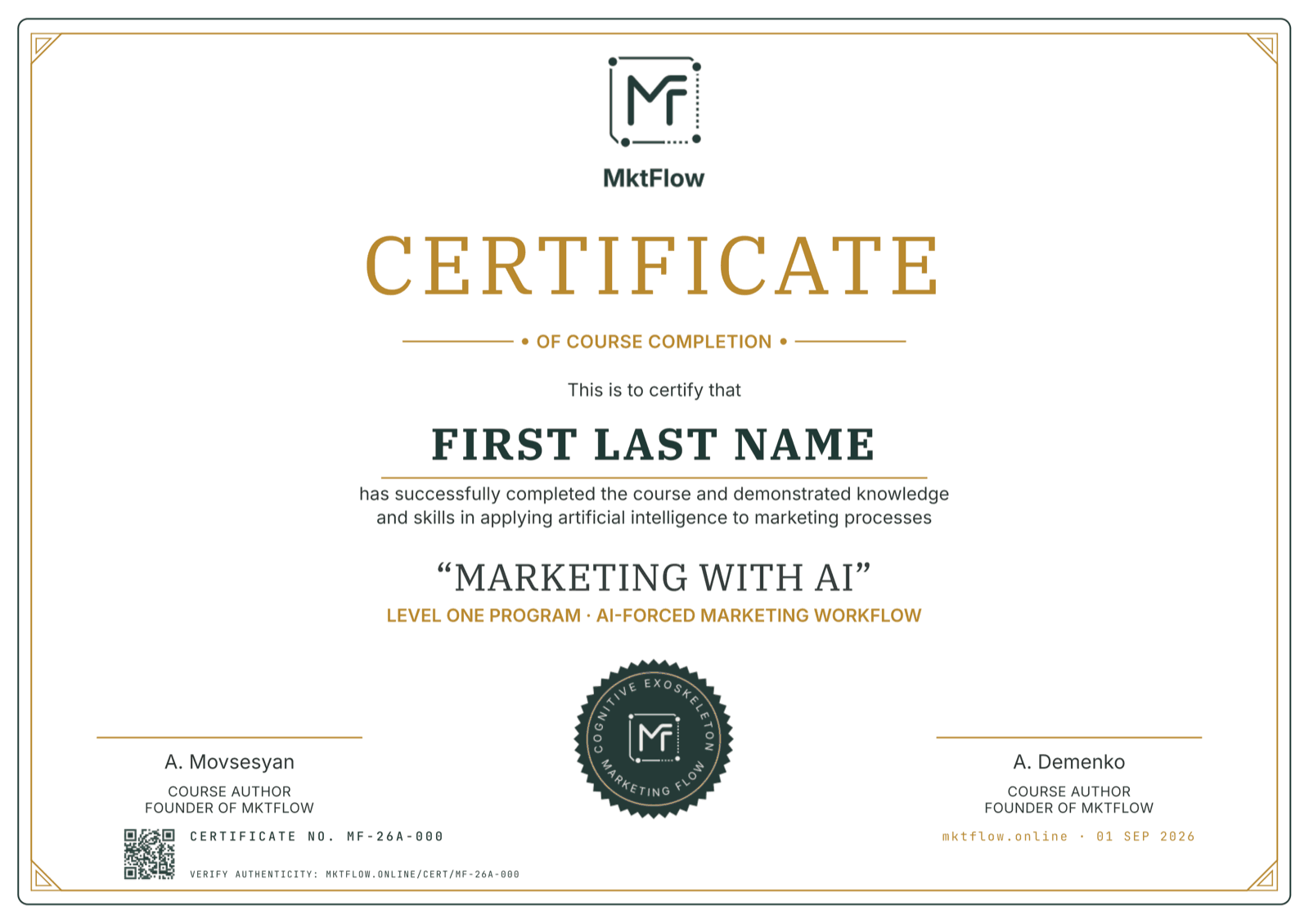
After defending your personal AI Playbook, you receive a MktFlow certificate for completing the "Marketing with AI" course. The document confirms specific competencies you've acquired, not just attendance at lectures.
Confirms 7 competencies and 13 specific skills
Issued after defending your personal AI Playbook
Signed by the course instructors
Includes a list of completed workflows and artifacts
Suitable for a resume and portfolio as a case study of applying AI to real tasks
Pricing
Cost
You can join with the first block for €120 and decide as you go whether to continue. The top-up to the full programme is €370 and opens when a group has open seats.
Block A
€120
5 modules, 13 hours
Core AI skills and the AI Toolkit
P.R.E.S.S. prompt framework
HITL verification checklist
Access to the mktflow.online platform
Continue with a €370 top-up
Full course
€1,200€490
15 modules, 29 hours, one-time payment
All three parts of the programme
Access to the mktflow.online platform
API keys for the training period
P.R.E.S.S. prompt library
MktFlow certificate
No VPN required
Corporate
On request
for teams of 3 or more
Case studies adapted to your industry
Corporate contract and closing documents
Group discount for 5+ participants
The €370 top-up is paid after Block A and depends on open seats in the group. We confirm your seat before payment.
Corporate training
Why send your marketer on this course
An employee who has embedded AI into their daily workflow speeds up analytical and communication tasks without losing quality and without becoming overly dependent on tools.
Faster analytics
Market research, competitive analysis and segmentation used to take days — now they shrink to hours, while verification and the quality of conclusions hold up.
A shared prompting standard
The P.R.E.S.S. framework helps the team speak to AI in one language. Instead of improvised requests, you use reproducible prompts. That makes results consistent and easy to check.
Managed quality
HITL verification lowers the risk of AI errors in strategic documents. An employee knows what to check and how, instead of blind trust or excessive caution.
Readiness for agentic AI
Part C builds an understanding of when an AI agent is needed and when ChatGPT is enough. That cuts spending on misdirected agentic implementations.
A portfolio of artifacts
By the end of the course, the employee has 15 working artifacts: a prompt library, a HITL checklist, an AI decision matrix. These are tools in daily use, not knowledge "in their head."
A corporate format
For teams of 3 or more, the course can run in a corporate format with cases adapted to your industry. Contact the MktFlow team for details.
The course builds the foundation for moving to the advanced level: agentic automation of marketing functions. Figures from industry sources (Gartner 2025, Alvarez & Marsal 2026).
−60%
time on Keyword Research when switching to an AI workflow
+40%
conversion with AI-based lead qualification (Lead Qualification workflow)
+35%
engagement with Dynamic Content Generation and personalisation
81%
of market leaders are piloting agentic systems in marketing (Gartner, 2025)
Part C of the course lays the language for making automation decisions. The full cycle of implementing AI agents in the marketing function is covered in the advanced module. Access to it opens only after you complete the base course.
After the base course, an advanced level opens up with the full cycle of implementing AI agents in the marketing function. From connectors and an n8n practicum to production operation with a governance framework.
Connectors and no-code data connections
n8n practicum: 4 working workflows
7 AI workflows for marketing with KPIs and HITL
Implementation, governance and 5 critical risks
APIs and the MCP protocol
Vibe-coding internal tools
Capstone: orchestrating a digital team of agents
Aimed at heads of marketing and those who have completed the base course and are ready to implement agentic workflows at their company. Enrollment opens after you complete the base course.
Frequently asked questions
FAQ
We don't teach a list of tools — we teach how to embed AI into the full marketing cycle: from market analysis and segmentation to positioning, CJM and campaigns. Tools are treated as part of a system, not as an end in themselves.
The focus is on workflow: you follow the path "real task → marketing methodology → AI as an amplifier." Tools are treated as part of the system, not as the goal. The course teaches principles, and they stay valid as tools change.
You'll see how to turn "write a text" requests into a sequence of steps: research, hypotheses, verification. Then AI gives you structural marketing conclusions instead of generic phrases. That's exactly what the P.R.E.S.S. framework is built for.
After the course you'll be able to do market and audience analysis, segmentation, customer journey mapping, positioning, brand modelling and the foundation of a communication strategy with AI, faster and more systematically, with verification at every stage.
The course is designed for practicing marketers with 3–7 years of experience: a basic marketing foundation is assumed, and we add the AI tools and methodology layer on top. Deep analytics knowledge isn't required.
Yes, this is one of our key scenarios: we move from "knowing about AI" to specific working scenarios and standards you can implement in your daily tasks.
If you're confident in marketing but new to AI, you'll manage just fine: we give you the AI foundation and immediately show you how to tie it to marketing tasks you already know.
29 academic hours, 15 modules across 3 parts (A: 13h, B: 14h, C: 2h). Split: lectures 45% / practicum 35% / lab sessions 20%. The exact schedule and weekly load are confirmed when you enroll.
The core exercises are tied to the real cycle: market analysis, segmentation, positioning, product and communication strategy. You use AI on your own tasks, or ones as close to real as possible.
The course is designed so you can apply its approaches to your own tasks. Whether working through personal projects is mandatory or optional is something to confirm with the instructors when you enroll.
Yes, the course includes a dedicated block on verification: how to cross-check AI conclusions, compare them against data, and avoid handing management raw or mistaken insights. You build the HITL checklist in module A3 and apply it in every module after that.
We constantly work from classic marketing logic: first the task and the hypothesis, then framing the AI request, then critically evaluating the output. That way AI amplifies your decisions instead of replacing them.
The course is aimed at speeding up analysis, brief preparation, strategy drafts and supporting materials, cutting a chunk of routine work several times over. Exact time savings depend on your context and are calculated individually.
The goal of the course is for you to end up with a documented marketing case built with AI (research, hypotheses, decisions) that you can show internally at your company or in an interview. Plus 15 module artifacts and a personal AI Playbook. And of course our certificate.
You'll be able to honestly show experience applying AI to specific marketing tasks, rather than "I know ChatGPT." That kind of experience translates into cases, results and language that hiring managers understand.
The emphasis on practice means more than watching lectures. Confirm with the instructors which feedback format suits you — it can be individual, group, or cover only the key assignments. Our tutor takes care of any issues, and exchanging notes with fellow students in our chat is encouraged. You'll hear about all of this before enrolling.
The availability of a flexible pace, deadlines and support mechanisms (chats, reminders, extra slots) is confirmed when you enroll. We'll walk you through the current intake format.
The policy on access duration and updates is confirmed when you enroll. Given how fast the AI field moves, this point matters, and we discuss it separately with every participant.
Next intake — November 2026
Enroll in the "Marketing with AI" course
Cohort of up to 20 people. Leave a request. We'll get in touch, clarify the details and find the right format for you. No VPN required. Accounts and access to AI models are provided.
P.R.E.S.S. prompt library on enrollment
Access to the mktflow.online platform included
API keys provided for the training period
Certificate after defending your AI Playbook
Instalment payment available
Leave a request
Not sure the course is right for you? We offer a free 15-minute consultation.
Enroll in the course
Marketing with AI — November 2026, cohort up to 20 people
We use cookies to improve the site. By continuing to use it, you agree to our privacy policy.
Leave a request
Marketing with AI — November 2026, cohort up to 20 people